
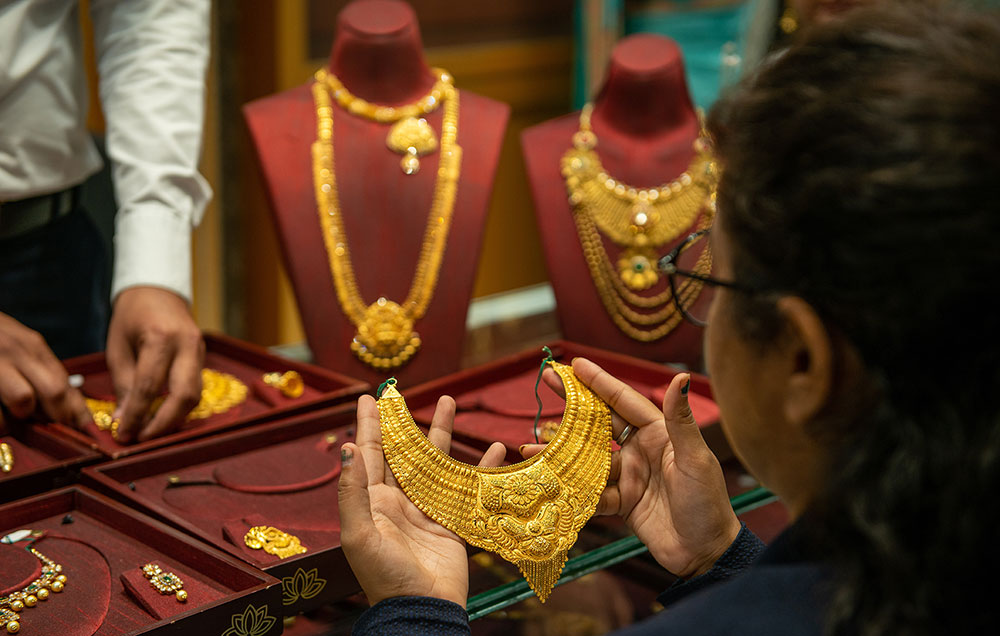
Indian households may hold as much as USD 5 trillion worth of gold, but much of this wealth remains outside the productive economy. With gold imports touching USD 72 billion a year, call to unlock household gold rises, while raising a difficult question: can India monetise its gold without changing the centuries-old relationship the people have with the yellow metal?
One of India’s top industrialists and bankers, Uday Kotak, has once again stirred a hornet’s nest with his remarks on gold. While the yellow metal has created significant wealth for domestic households, its largely unproductive nature, he argues, has also exacerbated the country’s current account deficit (CAD) problem, while limiting its potential to contribute to economic activity, income generation and productive reinvestment.
Kotak is among the growing tribe that is pitching for a policy to bring the household gold into formal economy.
Just to share some perspective, it is estimated that Indian households possess between 25,000-35,000 tonnes of gold which is worth over Rs 380 lakh crore in a base case and 480 lakh crores in the most optimistic case. In dollar terms, up to USD 5 trillion or 125% of the country’s Gross Domestic Product (GDP).
Meanwhile, India’s sovereign gold reserves stand at approximately 880 tonnes while those of the US and China are around 8,133 tonnes and 2,366 tonnes, respectively.
India’s CAD stood at USD 25 billion in FY26 and even if half of the holding is unlocked, the imports would come down, likely making us current account surplus.
For an average Indian, gold is much more than an asset. It is a way of life and an integral part of the country’s cultural ethos. We have a deep-rooted affinity for gold and traditionally feel the urge to buy it during festivals and the wedding season.
India imported USD 72 billion worth of gold in the financial year 2024-25 and this could rise to USD 90 billion in FY27, Kotak opines.
The fact that India remains a net importer, the growing gold imports accentuate its problems. We import crude oil, liquified natural gas (LNG) for our energy requirements; edible oil and pulses, raw material like APIs for medicines; phosphate, natural gas and sulphur to produce fertilizers; electronics and defence equipment are among other major imports. These are items which we cannot do without and hence gold often gets the blame for being the CAD spoiler.
Key demand driver
Despite financialisation of bullion (gold and silver), physical gold remains a prized catch for Indian households because it is not just a commodity or a store of value for the people but a sentiment.
Indians buy gold throughout the year, but demand typically surges around major festivals such as Diwali, Durga Puja, Akshaya Tritiya, Baisakhi and Karva Chauth. In South India, consumers throng jewellery stores during festivals such as Pongal, Onam and Ugadi. Gold demand also receives a significant boost during the wedding season, which spans nearly six months of the year—roughly April to June and November to February.
It also finds its way to the household lockers in the form of gifts.
Gold’s appeal remains unmatched as a store of value and an asset that can be liquidated virtually anywhere in the world. It is widely regarded as a hedge against inflation, currency depreciation and economic uncertainty. Unlike fiat currencies, equities or cryptocurrencies, gold is not subject to the risk of being devalued through monetary policy, corporate actions or the collapse of an individual issuer.
Gold demand by sector
According to a report by World Gold Council, the jewellery sector created a demand of 141 tonnes in the six months ended June 30 which was 17 per cent lower from 170 tonnes in the same period in 2025.
The demand decline could be attributed to a significant uptick in gold prices in the year gone by. It could also be linked to the hike in import duty to 15 per cent in May from an earlier 6 per cent.
Notwithstanding a demand slowdown in jewellery, the industry earned 40% more in value terms, thanks to the exaggerated prices that hit the roof, taking the domestic gold rate to a whopping Rs 1.84 lakh per 10 grams. The H1’26, the jewellery segment generated a revenue of Rs 2.13 lakh crore compared to Rs 1.52 lakh crore in the same period in 2025.
Notably, India still led the demand in key markets ahead of China, the United States, Saudi Arabia, Turkey, Russia and the UAE,
The demand for gold bars and coins shot up 21 per cent in H1 – 26 to 113 tonnes, that accounted for nearly Rs 1.7 lakh crore in revenue, up from 93 tonnes in H1 – 25. The revenue in the corresponding period stood at Rs 82,660 crore.
Meanwhile, industrial demand also took a 6 per cent hit to 4.2 tonnes in H1’26 from 4.4 tonnes in H1’25. In terms of value, it increased 76 per cent to Rs 6,900 crore from 3,930 crore in the year ago period.
As Kotak appealed the government to devise a strategy, the solution is unlikely to be an easy one. The government has burnt its finger after launching the Sovereign Gold Bond (SGB) scheme in 2015 and then closing it prematurely in 2024 after gold prices rose unabated. It had promised a 2.5 percent interest on gold on top of capital appreciation on it to encourage paper gold and reduce the physical consumption.
It will not be an easy task to persuade people to take out gold from their lockers. It will be noteworthy to watch the impending attempts towards taming this glittering conundrum.