
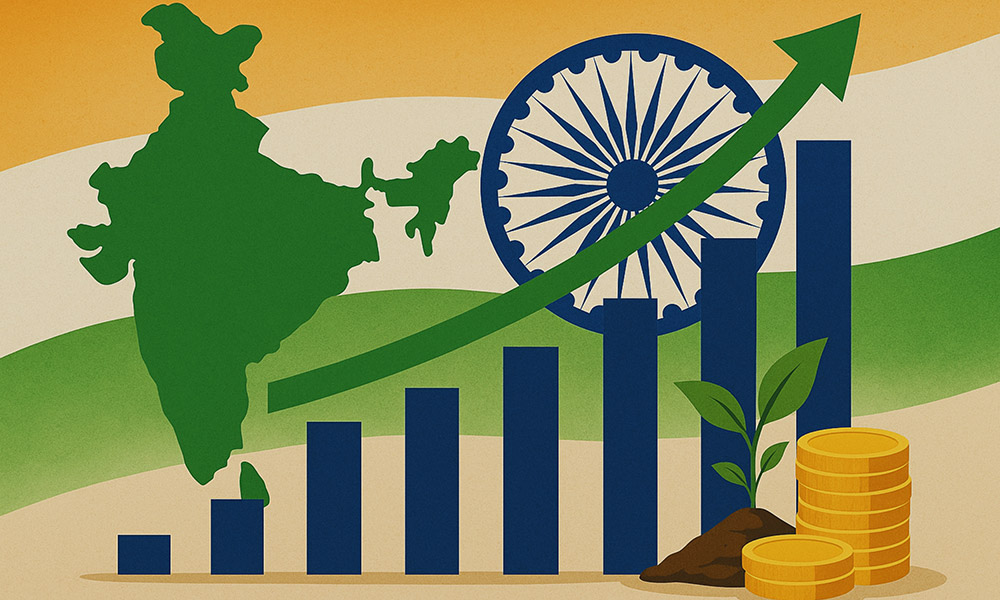
Moody’s Ratings has delivered a cautiously optimistic assessment of India’s economic trajectory, projecting that the country will maintain growth of around 6.5 per cent through 2027. In its latest macroeconomic report titled “Global Macro 2026: India’s Growth Will Be Steady but Subdued in 2026,” the agency reiterates that India continues to defy global economic strains, geopolitical uncertainty, and even targeted tariff increases by the United States. The report keeps India’s GDP growth forecast unchanged at 6.4 per cent for 2026 and 6.5 per cent for 2027, underlining the expectation of a stable — though not explosive — growth phase.
This outlook is significant for two reasons. First, India remains one of the world’s fastest-growing major economies at a time when most advanced markets are facing prolonged stagnation. Secondly, Moody’s categorisation of India’s growth as “steady but subdued” signals both confidence and caution: while the macro-fundamentals are strong, the next stage of economic expansion will demand deeper structural reforms and investment momentum.
A Resilient Economy Amid Global Crosswinds
Moody’s attributes India’s resilience to a combination of structural strengths, stable policies, and an increasingly diversified economic engine. Despite a turbulent international landscape — marked by trade tensions, global monetary tightening, and weakened consumer demand across major economies — India has managed to maintain a growth rate enviable by global standards.
Robust Domestic Demand Base
A key pillar of India’s sturdiness is its strong domestic market. Consumption remains the backbone of the economy, powered by a rising middle class, expanding urbanisation, and improving financial inclusion. India’s internal demand has consistently cushioned the economy against external shocks, allowing it to weather global contractions better than many export-dependent nations.
Investment, particularly in public infrastructure, is another driver reinforcing the domestic foundation. Large-scale capital expenditure on roads, ports, railways, logistics corridors, and digital infrastructure has created a long-term multiplier effect, boosting employment, productivity, and investor confidence.
More Diversified Export Profile
While high U.S. tariffs have affected specific Indian exports, Moody’s notes that India’s external sector has become considerably more flexible than before. Services exports — especially in IT, digital services, professional consulting, and global capability centres — continue to thrive. Goods exports have also gradually diversified into electronics, pharmaceuticals, chemicals, specialty manufacturing, and renewable-energy components.
This diversification helps absorb shocks from tariff actions or global downturns, enabling India to maintain momentum even when traditional export streams face headwinds.
Stable Macro-Economic Management
Moody’s emphasises that India’s current macroeconomic framework remains stable despite global volatility. Inflation has moderated compared to the post-pandemic spikes, enabling the Reserve Bank of India to maintain a balanced monetary stance. Fiscal spending continues to prioritise capital expenditure rather than short-term consumption, which strengthens long-term growth prospects.
India’s external balances remain manageable, supported by robust forex reserves, steady remittances, and increasing foreign investor interest in Indian equity and bond markets.
A Strong Demographic Advantage
India’s demographic profile continues to offer a structural advantage: a young, expanding workforce and massive potential for productivity gains. As the global labour pool contracts in many regions, India’s sheer scale of human capital remains a key growth enabler — provided it is matched with adequate skilling, job creation, and technological adoption.
Why Moody’s Calls Growth “Steady but Subdued”
While Moody’s recognises the economy’s resilience, the use of the word “subdued” is deliberate. It signals that while India will grow faster than most countries, there are real constraints that could prevent a breakout to higher growth levels.
- Cautious Private-Sector Investment
India has seen a strong government-led infrastructure push, but private corporate investment has yet to accelerate meaningfully. Companies remain cautious due to global uncertainty, uneven domestic demand across regions, and tighter international financial conditions. Without a full-fledged private investment cycle, economic expansion will remain steady but capped. - Persistent Global Risks
Global growth is expected to remain sluggish over the next two years. Slower expansion in major export markets — including the U.S., Europe, and parts of Asia — means India cannot rely heavily on external demand. Higher tariffs on selected Indian goods add further pressure.
Additionally, global politics, energy price fluctuations, and supply-chain disruptions pose ongoing risks that may spill over into India’s economy. - Structural Bottlenecks at Home
Despite substantial progress, India continues to face challenges that limit productivity:
- Labour market rigidities
- Logistics and supply-chain inefficiencies
- Land acquisition delays
- Uneven regulatory environments across states
- Gaps in urban planning and public service delivery
Unless these issues are addressed systematically, India’s growth may remain below its full potential.
- Inflation and Policy Trade-offs
Although inflation has moderated, risk factors remain. Persistent food-price volatility, imported inflation due to global commodities, or supply shocks can force monetary tightening, thereby slowing growth. Policymakers will need to balance inflation management with growth support carefully.
Implications for India Through 2026–27
Moody’s medium-term outlook sets the tone for India’s economic strategy over the next few years. Several takeaways emerge from the 6.4–6.5 per cent projection band.
- Policy Continuity Will Be Essential
India’s biggest growth differentiator in recent years has been predictable policy direction: emphasis on infrastructure, digital public goods, ease of doing business, and financial inclusion. Maintaining this continuity — while accelerating implementation — will be key to sustaining steady growth.
Regulatory streamlining, faster dispute resolution, and improved tax clarity are essential to boost private investment.
- Domestic Demand Will Remain the Growth Engine
With global growth expected to remain weak, India’s internal market must drive expansion. This requires:
- Strong job creation
- Higher rural incomes
- Continued urban consumption growth
- Expansion of credit access for MSMEs
- Affordable housing and infrastructure buildup
Government policy must ensure that domestic economic activity remains broad-based and inclusive.
iii. Private Investment Revival is Crucial
A sustained upswing in corporate investment has the potential to lift growth above the “steady but subdued” trajectory. India needs greater risk appetite from companies, supported by:
- Stable interest rates
- Lower cost of capital
- Clear industrial policies
- Rapid progress in manufacturing ecosystems
- Incentives for technology adoption and innovation
Sectors such as electronics, EVs, green hydrogen, semiconductors, pharmaceuticals, and defence manufacturing offer immediate opportunities.
- Export Competitiveness Must Deepen
India must prepare to succeed in a world of slower global trade. This requires:
- Faster integration into global value chains
- Leveraging trade agreements with key partners
- Reducing logistics costs
- Enhancing product standards and compliance
- Scaling manufacturing quality
While services exports continue to outperform, boosting goods exports will be key to achieving higher sustainable growth.
- Productivity and Human Capital Reforms Will Shape Long-Term Growth
With India approaching middle-income status, productivity becomes the main determinant of future growth. Policies must focus on:
- Quality skilling
- Modernising industrial clusters
- Digitising SMEs
- Encouraging innovation and R&D
- Strengthening the education-skill-employment pipeline
Human capital will increasingly determine India’s place in global value chains.
What Could Shift India Above or Below Moody’s Forecast?
Upside Triggers (Growth Could Exceed 6.5 per cent)
- A strong revival in private sector capex
- Breakthrough reforms in labour, land and logistics
- Rapid manufacturing expansion through PLI 2.0-type initiatives
- Large inflows into green and digital infrastructure
- A favourable global shift in supply chains towards India
Downside Risks (Growth Could Slow)
- Sharper global economic downturn
- Prolonged geopolitical conflict affecting energy prices
- Domestic inflation spikes forcing higher rates
- Weak monsoons or climate-related disruptions
- Persistent caution in private investment
India’s growth, therefore, remains robust but sensitive to both policy momentum and external shocks.
A Wider Comparison: How India Stands Globally
In a world where many advanced economies struggle to grow at even 1–2 per cent, India’s 6.5 per cent forecast positions it as a major outlier in a positive sense. This creates several strategic implications:
- India becomes a magnet for long-term global capital, particularly in manufacturing, green energy, digital services, and infrastructure.
- Emerging market leadership shifts — India could command greater influence in economic and trade negotiations.
- Risk-adjusted returns favour India as global investors rebalance portfolios toward high-growth geographies.
- Geopolitical relevance increases, as India becomes a stabilising force amid global uncertainty.
The Bigger Picture: India’s Next Phase of Growth
Moody’s projection ultimately signals a phase of “durable but moderate growth.” India is not heading into a high-growth sprint, but rather a stable climb. This shift has important implications:
- Growth quality matters more than the growth rate. Job creation, productivity gains, and equitable regional development will be key.
- Economic resilience becomes the central narrative. India is less vulnerable to global shocks than in previous decades, but not immune.
- Infrastructure and the digital economy remain key engines. Continued investment here will shape India’s competitiveness.
- Climate resilience and sustainable development will increasingly influence growth. As extreme weather and global climate policies evolve, India must align its growth ambitions with resilience planning.
Conclusion
Moody’s projection of 6.4 per cent GDP growth in 2026 and 6.5 per cent in 2027 reflects a blend of confidence and prudence. India has established itself as one of the strongest performing large economies in a deeply uncertain global environment. Yet, the journey ahead is about sustaining — not just celebrating — this growth.
The country’s ability to rise above the “steady but subdued” bracket will depend on whether private investment accelerates, productivity improves, and reforms deepen. The ingredients for stronger growth exist; the challenge now lies in execution.
In this sense, Moody’s report is not just a forecast — it is a reminder that India stands at a crucial inflection point. The next three years will determine whether the country settles into a stable mid-range growth cycle or breaks into a higher orbit driven by reform, innovation, and investment.