
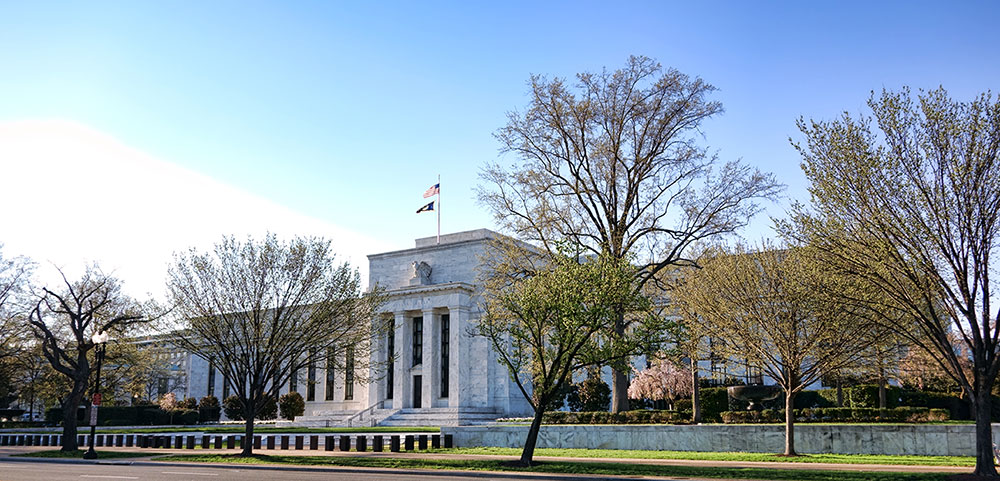
The US Federal Reserve has returned to rate hikes after a three-year hiatus, raising the federal funds target range by 25 basis points to 3.75 – 4 per cent as inflation remains stubbornly above its 2 per cent goal. The move has wider implications for emerging markets, including India, where a weakening rupee, elevated inflation and the risk of capital outflows are already complicating the Reserve Bank of India’s policy choices.
The US Federal Reserve finally bit the bullet to raise policy rate by 25 bps this week to bring it in the range of 3.75 per cent to 4 per cent in a unanimous vote (12:0), expressing concerns over the trajectory of inflation. The odds for a rate hike in India grow now as sticky inflation, weak rupee and excess liquidity in the domestic economy pose challenges.
The Fed’s decision to raise interest rates comes after a three-year hiatus, with inflation remaining stubbornly above its 2 per cent target. Personal Consumption Expenditures (PCE) inflation stood at 3.7 per cent year-on-year in July, while the six-month rate was higher at 4.1 per cent. August data are yet to be released, but inflation is expected to remain elevated.
The Fed’s 2 per cent inflation target has remained elusive since February 2021. Despite its best efforts, the US central bank has been unable to bring PCE inflation sustainably back to its target since the Covid-19 pandemic. The closest it came was in September 2024, when PCE inflation stood at 2.1 per cent.
The Fed’s stance remains unequivocally clear, prioritising price stability over growth, as the cost of living sees a sharp upturn. The US Central Bank is expected to make at least one more 25 bps rate hike this year or two in the worst-case scenario.
But the move surprised President Donald Trump’s supporters, even as he smells a rat, accusing the Board of Governors of being a “bunch of politicians” hostile to his administration. Handpicked by Trump, Fed Chair Kevin Warsh took over the baton from Jerome Powell in May this year. Warsh had been a strong proponent of cutting interest rates before assuming the chair, but his stance has since come under closer scrutiny.
While the US economy remains robust with resilient job market, the hike comes at a time when the world’s largest economy is staring at mid term elections due in December.
Global trends
Bank of Japan (BoJ) followed up with a quarter of a percentage hike as well, bringing the level to a 31-year high at 1.25 per cent. In a 7:2 split decision, the Japanese central bank quickened the rate hike cycle to three months versus six months previously after starting the monetary policy normalisation in March 2024.
Earlier, the European Central Bank (ECB) also increased policy rate to 2.5 per cent versus 2.25 per cent.
Meanwhile, the Bank of England remained an outlier, holding the interest rate to 3.75 per cent for the sixth time in a row.
The Indian picture
India faces challenges on multiple fronts notwithstanding the eye grabbing GDP numbers of 7.8 per cent in Q1. Our currency remains a big worry for the policy makers. The INR has slipped nearly 9 per cent over a one-year period. It breached the 96-mark against the greenback on Thursday following the Fed outcome.
The weakness persists despite a whopping USD 137 billion collection via currency swap scheme of the Reserve Bank of India (RBI) that concluded in August. Against the expectation of a USD 90-100 billion inflows, the banks collected USD 127.23 billion in Foreign Currency Non-Resident (FCNR B) deposits, while cornering USD 5.26 billion and USD 3.89 billion in Overseas Foreign Currency Borrowings (OFCBs) and External Commercial Borrowings (ECBs), respectively.
In the previous blog I argued why the deposit could only be a short-term measure to prevent the rupee slide and not a sustainable long-term measure. Its impact was swift as the rupee recovered 2.6 per cent to hit levels around 94 a dollar but the euphoria was equally short-lived.
Just to summarise, the blog highlighted how any escalation in the ongoing war between Iran and the US could potentially unsettle the fuel prices, delivering twin blows to us – spike in crude oil prices and weaker rupee requiring more dollars to buy a barrel of oil.
A spate of rate hikes in the US and other developing countries could restart the outflow from India as investments deliver better returns there. Moreover, a weaker rupee hits the dollar revenue of foreign investors making them averse to emerging economies like India.
Another major worry for us is the uncertainty over US tariffs and the delay in trade deal. However, the impression that India is bargaining hard to protect its own interests is a positive takeaway from the delayed trade deal.
It will be premature to gauge the likely impact of the latest sanctions by the US on countries who buy oil from Russia. The Lindsey O. Grahan Sanctioning Russia and Iran Act passed by the House of Representatives, is being seen yet another bargaining chip being used by Trump to browbeat other countries. The regulations have not raised alarms as yet and there is a high chance that India will be able to negotiate on this with the US administration, going ahead.
Will RBI follow suit?
There is a high probability that the RBI could undertake a couple of hikes in the repo rate in the upcoming monetary policies in October and December. There is a strong case now in favour of doing it, given the persistent rise in the headline inflation index.
The interest rates have stayed unchanged at 5.25 per cent since December 2025. The RBI slashed rates by 1.25 per cent in four successive policies between February and December.
The Consumer Price Index (CPI) rose to 4.82 per cent in August versus 4.45 per cent in July, witnessing a jump for the tenth time in a row. Rural inflation remains elevated at 5.23 per cent versus 4.31 per cent urban inflation. It is expected to go up further to 6.1 per cent in the third quarter according to some estimates, breaching RBI’s comfort zone of 4+/-2 per cent.
Food and fuel inflation continue to be pressure points for an average household. Retail food inflation, measured by the Consumer Food Price Index (CFPI) shot up to 5.95 per cent in August versus 5.52 per cent in July.
The wholesale inflation was reported at 9.92 per cent in August versus 9.78 per cent in July. A lion’s share was accounted for by fuel and power costs, that rose sharply to 22.93 per cent in August from 20.05 per cent in July.
We can also expect some monetary tightening as the banking system is now flushed with ample liquidity.