
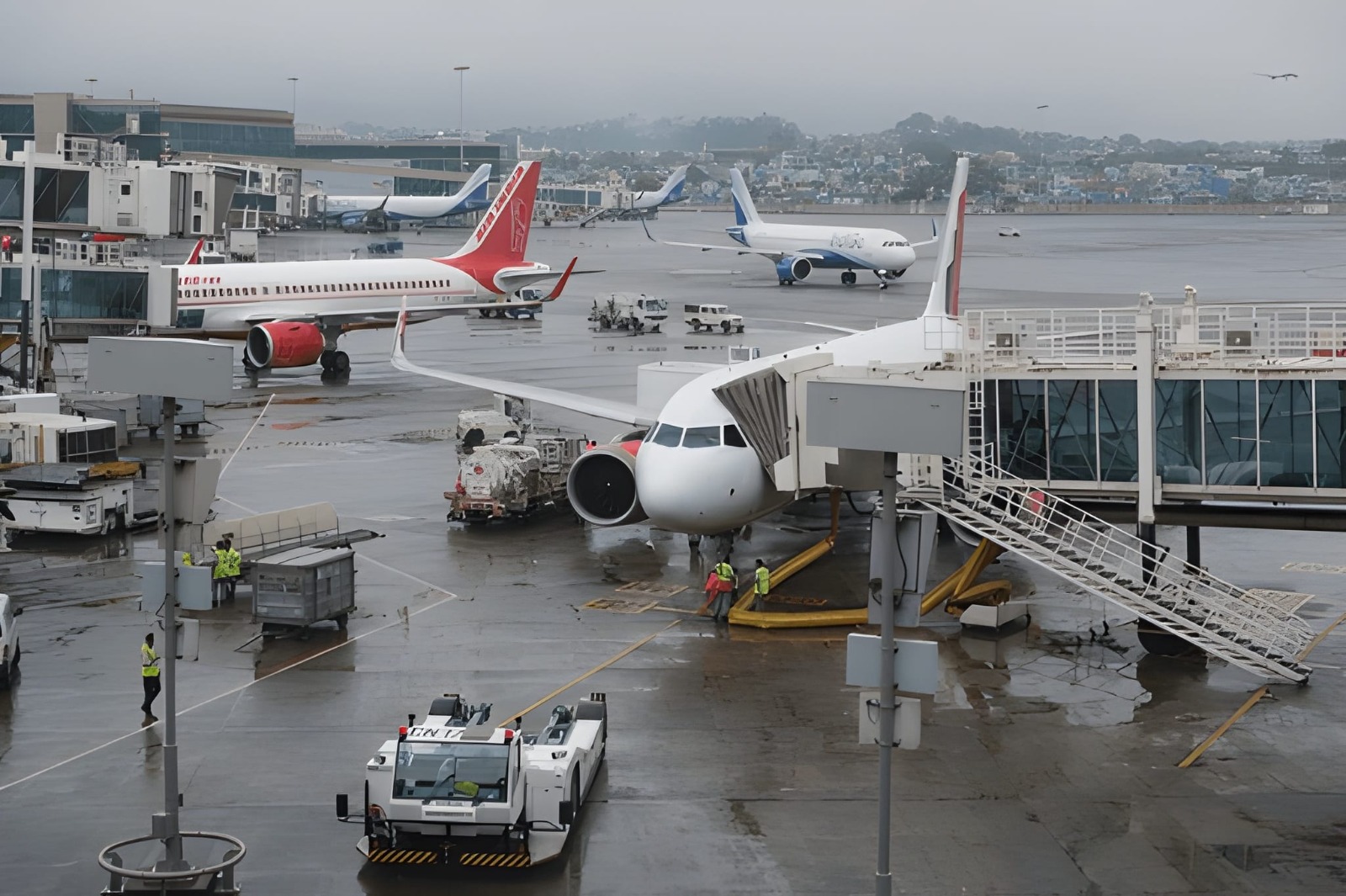
India has now emerged as the world’s fifth-largest aviation market. The International Air Transport Association (IATA) data revealed in that India handled 211 million passengers in 2024, an 11.1 per cent increase from the previous year, moving past Japan. Only the United States, China, the United Kingdom, and Spain are ahead of India.
India’s aviation sector is standing at the cusp of a structural transformation – one that transcends the narrow boundaries of airport infrastructure and enters the wider domain of regional development, logistics integration, and industrial growth. The age of the single metro airport – stretched beyond its capacity, shortened by urban sprawl, and constrained by airspace congestion – is giving way to a more strategic, distributed model: the integrated regional aviation hub.
This new paradigm, embodied by projects such as Noida International Airport near Jewar (IATA code: DXN) in Uttar Pradesh and Navi Mumbai International Airport (IATA code: NMI) in Maharashtra, is redefining what airports mean to a nation’s economy. They are no longer mere gateways to the sky – they are economic engines designed to anchor entire urban ecosystems.
From Congested Gateways to Connected Growth Engines
For decades, India’s air connectivity revolved around a handful of overburdened metropolitan hubs. Delhi’s Indira Gandhi International Airport and Mumbai’s Chhatrapati Shivaji Maharaj International Airport together handled a major burden of India’s passenger traffic. Despite continuous expansion – new terminals, parallel runways, automated baggage systems – both airports reached the physical and operational limits imposed by dense urbanization.
The consequences were predictable: airspace congestion, slot constraints, higher turnaround times, and an uneven distribution of air connectivity. Regional airports remained underutilized while metros groaned under the weight of demand.
The rise of Jewar and Navi Mumbai signals the end of that imbalance. These next-generation airports are conceived not as mere replacements but as integrated multi-modal hubs — seamlessly linking air transport with expressways, dedicated freight corridors, metro systems, and surrounding industrial and residential zones.
By situating airports at the intersection of infrastructure corridors — such as the Delhi–Mumbai Expressway, the Eastern and Western Dedicated Freight Corridors, and new urban transit networks — India is repositioning aviation as the backbone of regional transformation.
Jewar: The Prototype of a Future-Ready Hub
Located roughly 70 kilometres from New Delhi, the Noida International Airport at Jewar is being built on a foundation that combines foresight with functionality. Developed by Yamuna International Airport Pvt. Ltd. (YIAPL) – a subsidiary of Zurich Airport International – the project is more than just an aviation facility; it is a blueprint for aerotropolis-driven growth.
When its first phase becomes operational, Jewar will handle 12 million passengers annually, scaling up to 70 million in subsequent phases – rivalling Delhi airport itself. But the real story lies beneath the tarmac: a multi-sectoral integration strategy.
- Cargo and Logistics: Jewar is designed with a dedicated cargo terminal capable of handling 2 million tonnes per year, connected to the Delhi–Mumbai Industrial Corridor (DMIC) and the Eastern Peripheral Expressway, enabling just-in-time logistics for North India’s manufacturing and export clusters.
- Urban Planning Synergy: The surrounding Yamuna Expressway Industrial Development Authority (YEIDA) is developing logistics parks, industrial estates, and data centres that feed into the airport’s ecosystem. Planned residential townships, educational zones, and health districts are transforming the hinterland into a self-sustaining economic zone.
- Multimodal Integration: Jewar will connect to the Delhi Metro’s Aqua Line extension, the Delhi–Varanasi high-speed rail corridor, and the Yamuna Expressway, ensuring fluid mobility between the NCR subregions.
Jewar’s promise is not limited to decongesting IGIA (Indira Gandhi International Airport New Delhi); it is about redefining the National Capital Region (NCR) as a networked system of growth centres – Noida, Greater Noida, Ghaziabad, Faridabad – each linked through a shared aviation and logistics infrastructure.
Navi Mumbai: The Western Gateway Reinvented
If Jewar represents North India’s gateway to the future, Navi Mumbai International Airport (NMIA) is Maharashtra’s bold attempt to reclaim the efficiency and scalability that Mumbai lost decades ago. Conceived by the City and Industrial Development Corporation (CIDCO) and implemented by the Adani Group, NMIA is being developed as a twin-city hub to the saturated CSMIA.
The numbers are staggering: Rs. 17,000 crore investment, 6 runways (ultimate), 4 terminals, and a capacity of 90 million passengers annually. But beyond the engineering marvel lies an integrated design ethos.
The airport will connect directly to Mumbai Trans Harbour Link (MTHL), the Navi Mumbai Metro, and the Panvel–Karjat suburban railway, ensuring that air passengers, cargo, and urban commuters move across modes with minimal friction. The JLN Port Trust (JNPT), India’s largest container port, lies barely 15 km away – making NMIA a natural node for air–sea logistics integration, a first in India.
This strategic co-location transforms Navi Mumbai into a multimodal logistics powerhouse. Electronics, automotive, pharmaceuticals, and perishables exporters can now move high-value cargo from factory to port to aircraft within hours — reducing costs and turnaround time while expanding India’s competitiveness in global supply chains.
The airport’s sustainability features – extensive solar installations, rainwater harvesting, and smart terminal design – underscore a larger shift: integrated hubs are not just bigger, they are smarter, greener, and more adaptive to future aviation needs.
Why Integration Matters: The Economics of Connectivity
The idea of integration in aviation extends beyond infrastructure. It is a strategic economic concept. Integrated aviation hubs create powerful synergies between sectors that traditionally operated in silos.
- Industrial Clustering: Airports attract export-oriented industries – electronics, automotive components, pharmaceuticals, precision engineering – which thrive on fast, reliable logistics. Co-locating manufacturing with aviation reduces lead times and enhances supply chain resilience.
- Maintenance, Repair, and Overhaul (MRO): India’s MRO sector is projected to reach USD 4 billion by 2030. Integrated hubs like Jewar and Navi Mumbai can anchor dedicated MRO zones, leveraging proximity to both domestic and international airlines.
- Hospitality and Convention Ecosystems: Integrated hubs catalyse aerocity-type developments — hotels, convention centres, retail districts – that serve as magnets for investment and employment. The Aerocity model at IGI has already demonstrated this multiplier effect.
- Real Estate and Urban Expansion: Airports have historically redefined urban geography. Gurugram’s rise was tied to IGIA; Navi Mumbai’s next growth wave will likely follow its airport. Jewar could do the same for Western UP, turning farmland into a smart urban-industrial corridor.
The World Bank estimates that every USD 1 invested in airport infrastructure generates up to USD 3–5 in economic returns. When that investment is integrated – supported by expressways, industrial corridors, and urban planning – the multiplier can be even higher.
Global Parallels: Learning from the World’s Best
India’s integrated hub strategy mirrors the evolution of global aviation ecosystems:
- Singapore’s Changi Airport evolved into a global logistics and tourism hub through seamless integration with port, metro, and free-trade zones.
- Dubai’s Al Maktoum International Airport (DWC) was conceived as part of a 145 sq. km aerotropolis that includes logistics, exhibition, and residential zones – now a template for air-led urban planning.
- Incheon International Airport in South Korea anchors the Songdo International Business District – a model smart city driven by aviation-led connectivity.
- Istanbul Airport, operational since 2019, is the world’s largest integrated terminal hub, designed to connect Europe, Asia, and Africa through a unified multimodal network.
India’s Jewar, Navi Mumbai, and upcoming Chennai Greenfield Airport are building upon this lineage – but with a unique Indian context: balancing regional equity, sustainability, and economic decentralization.
Aviation as a Regional Development Engine
Unlike previous decades when airports were seen primarily as central government projects, the new generation of hubs reflects deep collaboration between state governments, private developers, and urban authorities. This cooperative federalism is critical to distributing growth.
Consider the Western UP corridor: Jewar airport, the Delhi–Mumbai Expressway, and the DMIC are collectively turning Noida–Aligarh–Agra–Mathura into a contiguous industrial belt. Similarly, the Mumbai Metropolitan Region (MMR) is now being imagined as a dual-city ecosystem – Mumbai as the financial core, Navi Mumbai as the logistics and industrial complement.
This is the regional multiplier effect at work. Integrated aviation hubs:
- Create new job markets – from construction to logistics, aviation services to hospitality.
- Attract FDI and private equity into surrounding industrial estates.
- Stimulate infrastructure investments in housing, healthcare, and education.
According to the Ministry of Civil Aviation, India’s airport expansion programme could contribute over USD 100 billion to GDP by 2035, provided it is matched with industrial and urban integration.
Sustainability and Resilience: The Green Blueprint
In an era where aviation is under pressure to decarbonize, integrated hubs provide an opportunity to embed sustainability at scale.
- Energy: Both Jewar and Navi Mumbai airports are designed to run on renewable energy, with on-site solar farms and smart energy management systems.
- Water and Waste: Closed-loop water systems, zero-discharge sewage treatment, and solid-waste segregation are being incorporated from day one.
- Mobility: By integrating with metros, high-speed rails, and EV corridors, these hubs can drastically reduce road congestion and emissions per passenger trip.
- Climate Resilience: New airports are being planned with flood-mitigation systems, heat-resilient materials, and green cover buffers – lessons learned from global climate disruptions.
Digital Integration: The Smart Hub Advantage
Beyond physical infrastructure, the next leap in hub design is digital. Integrated aviation hubs will be data-driven ecosystems connecting passengers, cargo, and city systems in real time.
- Smart Logistics Platforms: AI-enabled cargo tracking and blockchain-based supply chains will make freight operations faster and more transparent.
- Passenger Flow Analytics: Predictive analytics can optimize security queues, boarding processes, and ground transport availability.
- Digital Twin Technology: Jewar and Navi Mumbai are adopting digital twin models to simulate operations, energy use, and passenger movement – enabling proactive management and rapid scalability.
These digital layers will make India’s integrated hubs future-ready, resilient, and globally competitive.
The Investment Magnet: Private and Global Capital
India’s aviation infrastructure is among the most attractive destinations for global investors. The PPP model – proven in Delhi, Hyderabad, and Bengaluru – is now being replicated with greater sophistication.
Zurich Airport’s investment in Jewar and Adani Group’s stake in Navi Mumbai underline how foreign and domestic capital are converging to back India’s aviation story. The National Monetization Pipeline (NMP) and National Infrastructure Pipeline (NIP) have created policy stability for long-term investors.
Moreover, with the Udan Scheme expanding regional routes, integrated hubs are not isolated mega-projects; they are anchors for a networked national connectivity grid, enabling last-mile access for Tier-2 and Tier-3 cities.
Decongesting Metros, Empowering Regions
The philosophy behind integrated hubs goes beyond infrastructure efficiency. It is about rebalancing India’s urban map.
For decades, Delhi, Mumbai, Bengaluru, and Hyderabad concentrated both capital and connectivity. The next decade could witness emergent clusters – NCR (Jewar–Noida–Ghaziabad), MMR (Navi Mumbai–Panvel–Pune), Southern Triangle (Chennai–Hosur–Salem), and Western Corridor (Surat–Vadodara–Ahmedabad).
Each of these regions, anchored by integrated aviation hubs, will:
- Reduce migration pressure on metro cores,
- Create new urban identities, and
- Strengthen India’s participation in global manufacturing and services value chains.
A Vision Beyond 2030
By 2030, India is expected to be the world’s third-largest aviation market, with passenger numbers exceeding 400 million annually. But the real test lies not in how many planes take off, but in how integrated, sustainable, and inclusive that growth becomes.
Jewar and Navi Mumbai are not isolated stories. They are the first chapters of a national narrative where aviation drives urban evolution – linking industrial corridors to global markets, enabling smart cities, and turning once-rural hinterlands into dynamic growth zones.
The rise of integrated aviation hubs represents a fundamental shift in India’s development philosophy: from expanding capacity to designing connectivity, from building airports to building ecosystems.
As the skies open wider, India’s next flight path is not just upward – it’s outward and onward, connecting its people, cities, and economies in ways that were once unimaginable.